
Precision at Scale: The Hidden Challenge in America’s EV Battery Boom
Behind every gigafactory headline lies a quieter race—the race to engineer precision at a scale the U.S. has never seen before.

The United States is in the midst of an extraordinary industrial transformation. Automakers are investing tens of billions of dollars in battery manufacturing facilities across the country, an effort to localize production, secure supply chains, and accelerate the electric vehicle transition. From North Carolina to Kentucky to Michigan, massive gigafactories are rising seemingly overnight.
But beneath the headlines and megawatt-hour projections lies a quieter, more complex challenge: scaling precision. While cell chemistry tends to capture the spotlight, the long-term reliability and safety of every battery depends on the integrity of its mechanical components, particularly the precision-engineered assemblies that seal and protect each cell.
Where Microns Matter
In lithium-ion battery manufacturing, success is measured in microns. A lid assembly that deviates by even a fraction of a millimeter can compromise sealing, cause gas leakage, or affect internal pressure, issues that can impact both performance and safety. Maintaining these tolerances consistently across millions of units demands not only world-class tooling and process control but also deep expertise in high-volume precision metal forming.
This is where the future of battery manufacturing intersects with an often-overlooked discipline: advanced metal stamping.
Translating Precision Manufacturing Across Industries
From its inception in 1987, IntriPlex Technologies has supplied ultra-precise stamped components for the data storage industry, where consistency, cleanliness, and micro-scale tolerances are non-negotiable. Since then, the company has expanded its expertise into additional high-precision markets, including medical and fiber optics. Today, that same engineering DNA underpins IntriPlex’s work in lithium-ion battery component manufacturing, including the design and production of lid assemblies for cylindrical EV cells.
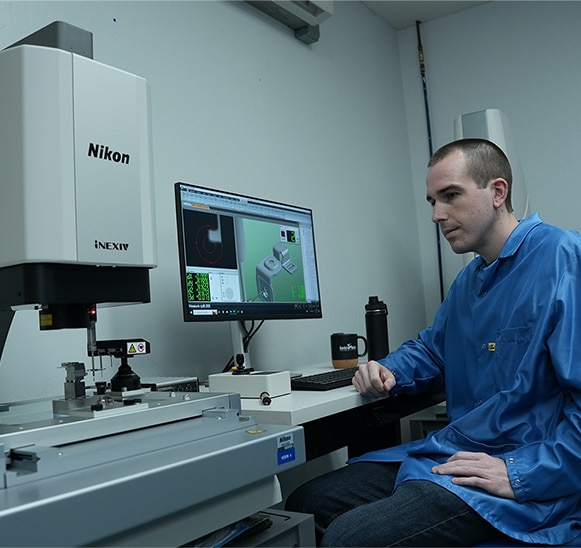
Each assembly requires a combination of dimensional accuracy, material integrity, and surface cleanliness that challenges traditional stamping and forming methods. By designing tooling in-house, maintaining tightly controlled environments, and using advanced inspection and testing processes, IntriPlex ensures the precision necessary for next-generation energy applications.
Enabling U.S. Manufacturing from the Inside Out
As automakers and cell manufacturers localize production in the U.S., the ability to replicate world-class quality domestically is emerging as a critical success factor. Establishing that ecosystem requires not only capital investment but also experienced partners who understand how to engineer precision at scale.
IntriPlex’s approach extends beyond manufacturing. Through its Innovation Center, OEMs and engineers can collaborate directly with IntriPlex’s technical teams, testing concepts, validating designs, and refining processes side by side. This kind of partnership accelerates innovation, reduces risk, and bridges the gap between prototype and production.
Positioned for What Comes Next
With its headquarters in California and plans to expand manufacturing capacity in the Southeast, where much of the nation’s new battery infrastructure is taking root, IntriPlex is strategically positioned to support the growing domestic supply chain. The company’s history of technical excellence, combined with its forward-looking investment in EV component manufacturing, underscores a broader commitment to strengthen U.S. manufacturing from the foundation up.
A Call to Precision
The next era of battery innovation will depend not just on breakthroughs in chemistry but on the mastery of precision engineering. For manufacturers, it is a reminder that progress in electrification does not only happen in laboratories or at the scale of gigafactories, it also happens in the pressroom, where microns make all the difference.